

Keynote Speakers
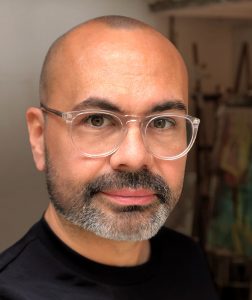
Professor,
Department of Contemporary Practices
School of the Art Institute of Chicago, USA
Title: On Drawing Technologies: Three Episodes.
Pablo Garcia is a Professor at the School of the Art Institute of Chicago, where his research-based creative practice explores and reframes historical artistic processes for a 21st-century audience. His work examines the intersection of forgotten analog methods and cutting-edge digital technologies, paying homage to centuries of human-machine collaboration in art and design. Through a multidisciplinary approach, he investigates art-and-technology relationships across site-specific installations, machine-assisted drawings, kinetic sculptures, optical illusions, speculative architectures, and original scholarship.
Since 2013, he has commercially produced the NeoLucida, a modern reinterpretation of the camera lucida. Initially designed as a media-archaeological research project, the device is now in the collections of international institutions such as the American Philosophical Society, the Yale Center for British Art, the Science Museum (London), the Polytechnic Museum (Moscow), and the Musée d’Art et d’Histoire (Geneva).
Prof. Garcia has twice been named a Fulbright Scholar, and his extensive research on 600 years of drawing machines, documented at DrawingMachines.org, is supported by a National Endowment for the Humanities Fellowship. Garcia holds degrees in architecture from Cornell University and Princeton University.
Title: On Drawing Technologies: Three Episodes.

photo credit Christa Sommerer and Laurent Mignoneau
Professor of Art and Technology and Professor of Physics, UT Dallas, USA President Association Leonardo, Paris, France
Title: CaravanserAI
Roger Frank Malina is a hybrid researcher, educator, former editor, former astrophysicist. Co-founded the ArtSciLab. And Co-Director of the Off Center for Emergence Studies at UTDallas. We develop data performance, transdisciplinary, transcultural and transgenerational convergence research; our current publishing platform is called Creative Disturbance. President of the Observatoire Leonardo des Arts et Technosciences in Paris. Former NASA PI University of California Berkeley Extreme Ultraviolet Explorer satellite. Former CNRS Director Observatoire Astronomique de Marseille Provence, Marseille. Former Executive Editor Leonardo Journal and Book Series, MIT Press. BS Physics MIT 1972, PhD Astronomy UC, Berkeley 1979. Honorary Doctorate from the Polytechnic University of Valencia..
Title:CaravanserAI
Collaboration between local and non local intelligences
We live in a world of ciber-aldeas or ciber-villages. Indigenous communities around the world engage in oral cultures anew. However, its not only humans that connect on line but also other species that have been equipped with sensors, and of course AI. This is a phenomenon of auto-poetic emergence in a complex system- such systems can anticipate when AI can only predict based on the past. These can be compared to the caravanserai in the middle east that were located on trade routes and shared ideas and facts and food. There is no food yet in Caravanserai except food for thought. I will discuss practical applications of these concepts that may help us reduce the number of people killed in wars which like climate change we don’t yet control. We don’t need art and technology etc. We need inter-intelligence methods.
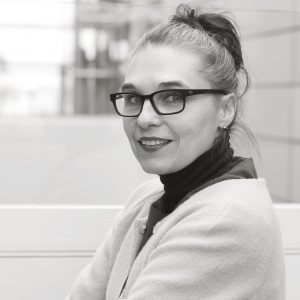
photo credit Anette Friedel
Manuela Naveau
Title: UNBEHAGEN in art and technology
when critical data touches the shadow of the invisible
Manuela Naveau, PhD is a university professor, independent curator, and art-based researcher. Over the course of nearly 18 years at Ars Electronica, she served as Head of Ars Electronica Export, co-developing the department and overseeing its operations from its founding onward. Since 2020, she has been Professor of Interface Cultures / Critical Data at the University of Arts Linz, Austria. In February 2023, she assumed leadership of the department Interface Cultures and founded the Critical Data Research Group.
Her research focuses on Media Art and Digital Art, with particular attention to processes of digital participation and interaction. Her work investigates data and data-processing systems through artistic research methodologies and interdisciplinary theoretical and practical frameworks, with a primary focus on discrimination- and disadvantage-critical perspectives.
A central contribution of her research addresses participatory processes in Media Art and Digital Art, whose long-standing traditions have often remained overlooked in contemporary art criticism and art theory. Her PhD thesis, later published as the monograph Crowd and Art, established an important theoretical contribution to the field. She has since published numerous papers and articles on participation in art and regularly lectures internationally on these topics.
Title: UNBEHAGEN in art and technology
when critical data touches the shadow of the invisible
